

Cable assembly vs wiring harness — understand the key differences, applications, benefits, and how to choose the right electrical solution for your project.
Introduction
In industries such as automotive manufacturing, industrial automation, electronics, aerospace, and renewable energy, reliable electrical connectivity is essential for performance and safety. Two of the most commonly used interconnection solutions are cable assemblies and wiring harnesses. Although these terms are often used interchangeably, they serve different purposes and are designed for different applications.
Understanding the difference between a cable assembly and a wiring harness is important for engineers, OEMs, procurement teams, and product designers. Selecting the wrong solution can lead to installation challenges, increased maintenance costs, reduced reliability, and unnecessary manufacturing expenses.
This guide explains the Cable Assembly vs. Wiring Harness comparison in detail, including their structures, functions, applications, advantages, and key selection criteria. By the end of this article, you will have a clear understanding of which solution best suits your project requirements.
What Is a Cable Assembly?
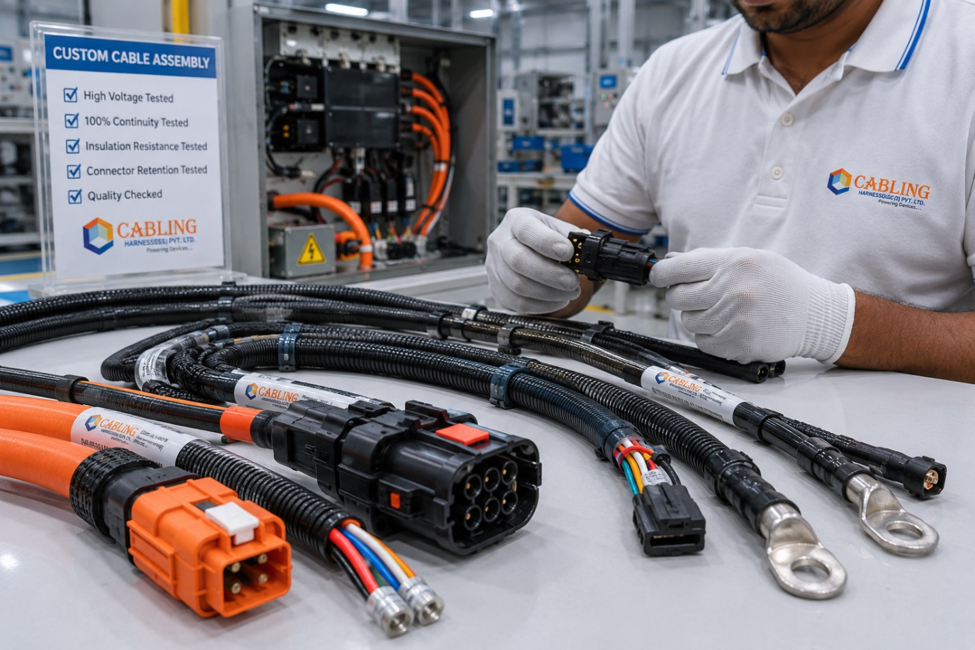
A cable assembly is a group of insulated conductors bundled together within a protective outer jacket and terminated with connectors, terminals, or other hardware at one or both ends. It functions as a complete, self-contained electrical connection between two defined points.
The primary purpose of a cable assembly is to transmit power, signals, or data while protecting the internal conductors from environmental factors such as moisture, abrasion, chemicals, heat, and vibration.
Cable assemblies are commonly used in applications where durability, environmental protection, and easy replacement are important.
Common Examples of Cable Assemblies
- Power supply cables
- USB and Ethernet cables
- EV battery interconnect cables
- RF coaxial cable assemblies
- Solar power DC cable assemblies
- Industrial machine power cables
Key Benefits of Cable Assemblies
- Excellent environmental protection
- Easy installation and replacement
- Reduced cable clutter
- Improved durability in harsh conditions
- Reliable signal and power transmission
What Is a Wiring Harness?
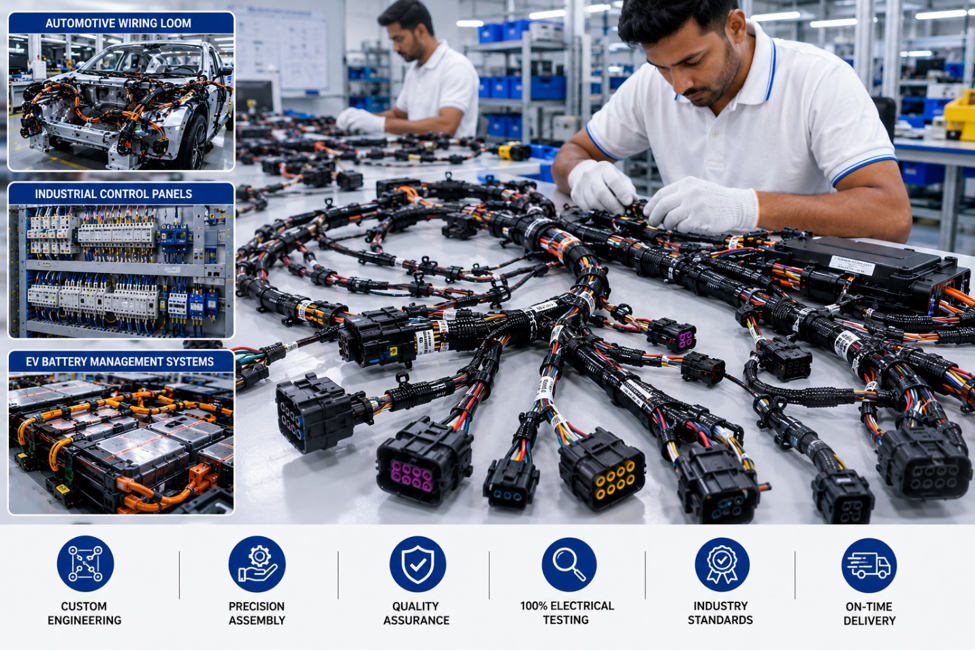
A wiring harness is an organized arrangement of multiple wires, cables, connectors, terminals, and protective coverings designed to distribute electrical power and signals throughout a system.
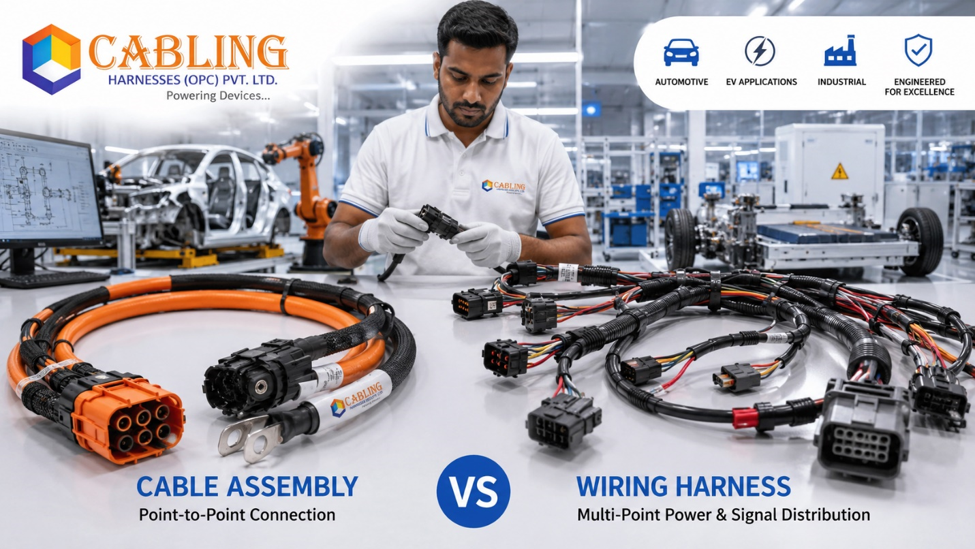
Unlike a cable assembly, which typically connects one point to another, a wiring harness serves multiple destinations through a structured network of branches and connection points.
A wiring harness acts as the electrical backbone of a product, ensuring efficient routing, simplified installation, and reliable operation.
Common Examples of Wiring Harnesses
- Automotive wiring systems
- EV battery management harnesses
- Industrial control panel harnesses
- Medical equipment harnesses
- Agricultural machinery harnesses
- Aerospace electrical systems
Key Benefits of Wiring Harnesses
- Simplifies installation processes
- Reduces assembly time
- Minimizes wiring errors
- Improves system organization
- Enhances reliability and serviceability
Cable Assembly vs Wiring Harness: Key Differences
1. Structure and Design
A cable assembly is typically a linear connection between two points enclosed within a protective outer jacket.
A wiring harness consists of multiple wires routed through a branching structure that distributes power and signals throughout an entire system.
2. Complexity
Cable assemblies generally have simpler designs and serve a specific connection function.
Wiring harnesses are significantly more complex because they integrate multiple circuits, connectors, and routing paths.
3. Installation
Cable assemblies are plug-and-play components that can be installed or replaced individually.
Wiring harnesses are integrated assemblies designed specifically for the equipment in which they are installed.
4. Customization
Many cable assemblies are available in standard configurations, although custom options are common.
Wiring harnesses are almost always custom-designed according to equipment layout, electrical requirements, and operating conditions.
5. Protection
Cable assemblies rely on a continuous outer jacket for protection.
Wiring harnesses use sleeves, conduit, tapes, clamps, and grommets strategically placed throughout the routing path.
6. Maintenance and Replacement
Cable assemblies can usually be replaced quickly without major system disassembly.
Wiring harness replacement often requires partial disassembly of equipment due to its integrated design.
Quick Comparison Table
| Feature | Cable Assembly | Wiring Harness |
| Function | Point-to-point connection | Multi-point power and signal distribution |
| Structure | Linear | Branched |
| Complexity | Low to Medium | Medium to High |
| Installation | Plug-and-play | Integrated assembly |
| Protection | Continuous outer jacket | Selective protective coverings |
| Customization | Standard or custom | Primarily custom |
| Maintenance | Easy replacement | More complex replacement |
| Typical Applications | Power, signal, and data transmission | Complete electrical systems |
Real-World Applications of Cable Assemblies
Electric Vehicles
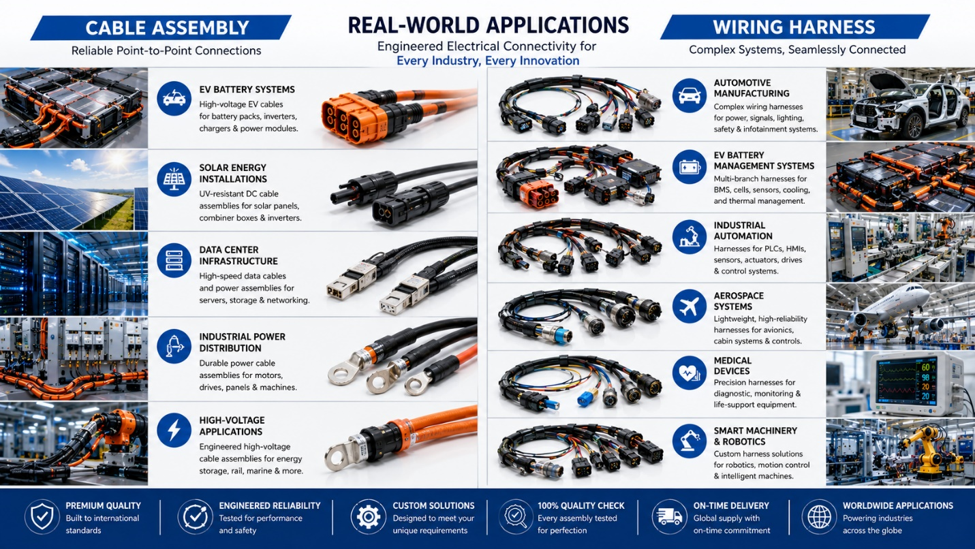
High-voltage battery cables connect battery packs, chargers, and power distribution units.
Industrial Equipment
Motor power cables and machine interconnect cables are commonly manufactured as cable assemblies.
Data Centers
Ethernet, fiber optic, and power distribution cables ensure reliable connectivity between servers and network equipment.
Renewable Energy Systems
Solar panel installations and battery storage systems rely on specialized cable assemblies for power transmission.
Real-World Applications for Wiring Harnesses
Automotive Industry
Modern vehicles contain extensive wiring harness systems responsible for power distribution, lighting, sensors, infotainment, and safety systems.
Industrial Automation
Control panel harnesses connect PLCs, sensors, HMIs, actuators, and drives.
Aerospace and Defense
Aircraft and defense systems depend on lightweight, highly reliable wiring harnesses capable of operating in demanding environments.
Medical Equipment
Diagnostic and monitoring equipment uses precision harnesses to connect sensors, displays, and control systems.
How to Choose Between a Cable Assembly and a Wiring Harness: Consider the following factors when selecting the right solution
Number of Connections
For simple point-to-point connections, a cable assembly is typically the best option.
For systems requiring multiple circuits and destinations, a wiring harness is generally more effective.
Installation Requirements
If quick installation and replacement are priorities, cable assemblies offer advantages.
For streamlined production-line assembly, wiring harnesses provide greater efficiency.
Environmental Conditions
Harsh environments often require specialized cable assemblies with robust protective jackets.
Complex equipment may benefit from harnesses that provide targeted protection along specific routes.
Production Volume
Custom wiring harnesses often provide long-term cost savings for high-volume manufacturing by reducing assembly labor and installation errors.
Frequently Asked Questions
Is a cable assembly the same as a wiring harness?
No. A cable assembly typically provides a point-to-point connection, while a wiring harness distributes power and signals throughout an entire system.
Which solution is better for electric vehicles?
Most EVs use both. Cable assemblies are commonly used for high-voltage power transmission, while wiring harnesses manage vehicle-wide electrical distribution.
Are wiring harnesses always custom-made?
Most wiring harnesses are custom designed to match the layout and electrical requirements of a specific product or vehicle.
Can one supplier manufacture both cable assemblies and wiring harnesses?
Yes. Many specialized manufacturers offer both solutions, providing greater consistency, quality control, and supply chain efficiency.
Conclusion
The Cable Assembly vs Wiring Harness comparison highlights two distinct electrical interconnection solutions that serve different functions within modern equipment and systems.
Cable assemblies are ideal for durable, point-to-point connections where environmental protection and easy replacement are important. Wiring harnesses, on the other hand, provide organized routes and distribution for complex systems that require multiple electrical connections.
By understanding these differences, engineers, OEMs, and procurement professionals can select the most effective solution for their applications, improving reliability, reducing installation complexity, and supporting long-term product performance.
Need a Cable Assembly, a Wiring Harness, or Both?
Cabling Harnesses (OPC) Private Limited specializes in custom cable assemblies and wiring harnesses for automotive, EV, industrial, aerospace, defense, and export applications.
Our engineering team works closely with OEMs, manufacturers, and procurement professionals to develop reliable, high-quality electrical interconnection solutions that meet international standards and demanding operating conditions.
Contact Us Today
📞 +91 73872 84670 / +91 9226275010
✉️ sales@cabling-harnesses.com
We welcome enquiries from OEMs, manufacturers, distributors, and procurement teams worldwide.
