

Discover the key differences between PCB assembly services and traditional wiring. Compare cost, reliability, scalability & manufacturing speed to choose the right solution
Introduction
In today’s rapidly evolving electronics manufacturing landscape, choosing the right interconnect strategy is one of the most consequential decisions an OEM or industrial design engineer can make. Whether you are building next-generation electric vehicles, industrial automation systems, medical devices, or defense electronics, the choice between PCB assembly services and traditional wiring harnesses directly impacts product reliability, manufacturing efficiency, cost structure, and long-term scalability.
Both technologies have earned their place in modern manufacturing — but understanding where each excels, and where each falls short, is what separates a well-engineered product from a costly redesign down the line.
Engineers who get this decision right at the design stage consistently report lower production costs, faster time-to-market, and significantly fewer field failures over a product’s service life.
On one side, SMT PCB assembly and automated printed circuit board manufacturing have transformed the electronics industry — enabling miniaturized, high-density electronic sub-systems that power everything from EV battery management units to industrial IoT controllers. On the other hand, wire harness manufacturing and custom cable assemblies remain the backbone of physical electrical architecture across automotive, aerospace, and heavy industrial platforms, where routing flexibility and high-current handling are non-negotiable.
This article delivers an honest, technically grounded comparison between PCB assembly and traditional wiring — drawn from real manufacturing experience across automotive, EV, industrial, and defense sectors — so you can make the right call for your next product or platform.
PCB Assembly Services Wire Harness Manufacturing Electronics Industrial Automation Decision Guide
PCB assembly involves mounting electronic components directly onto a printed circuit board using automated soldering, whereas traditional wiring uses discrete conductors and connectors to link components point-to-point. PCB assembly services offer higher reliability, compact form factors, faster manufacturing throughput, and superior scalability for high-volume production. Traditional wiring remains the preferred choice for heavy-current industrial power distribution, large-scale machinery, and custom low-volume applications where routing flexibility is critical.
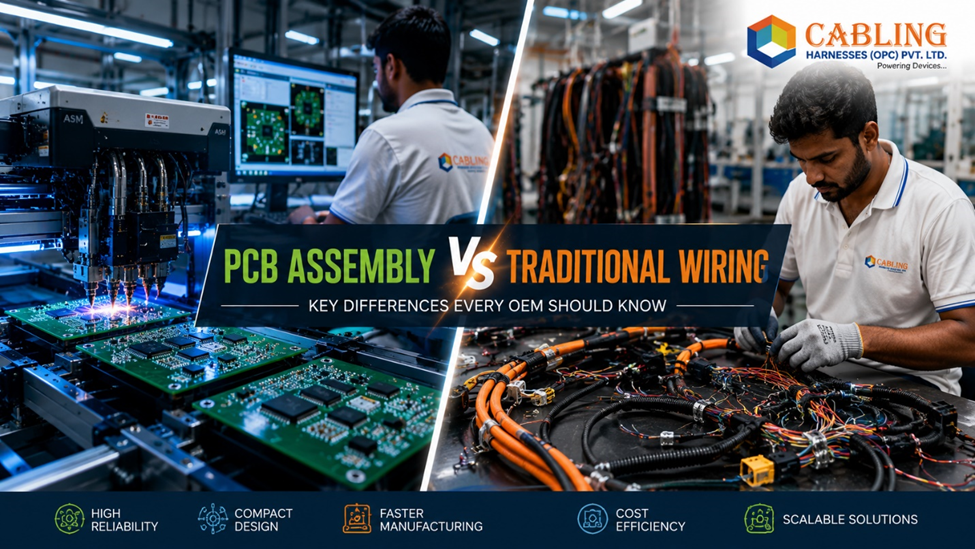
PCB Assembly vs Traditional Wiring: Key Differences Every OEM Should Know
In today’s rapidly evolving electronics manufacturing landscape, choosing the right interconnect strategy is one of the most consequential decisions an OEM or industrial design engineer can make. Whether you are building next-generation electric vehicles, industrial automation systems, medical devices, or defense electronics, the choice between PCB assembly services and traditional wiring harnesses directly impacts product reliability, manufacturing efficiency, cost structure, and long-term scalability.
Both technologies have earned their place in modern manufacturing — but understanding where each excels, and where each falls short, is what separates a well-engineered product from a costly redesign down the line.
This article offers an honest, technically grounded comparison between PCB assembly and traditional wiring — drawn from real-world manufacturing experience across the automotive, EV, industrial, and defense sectors.
What Is PCB Assembly?
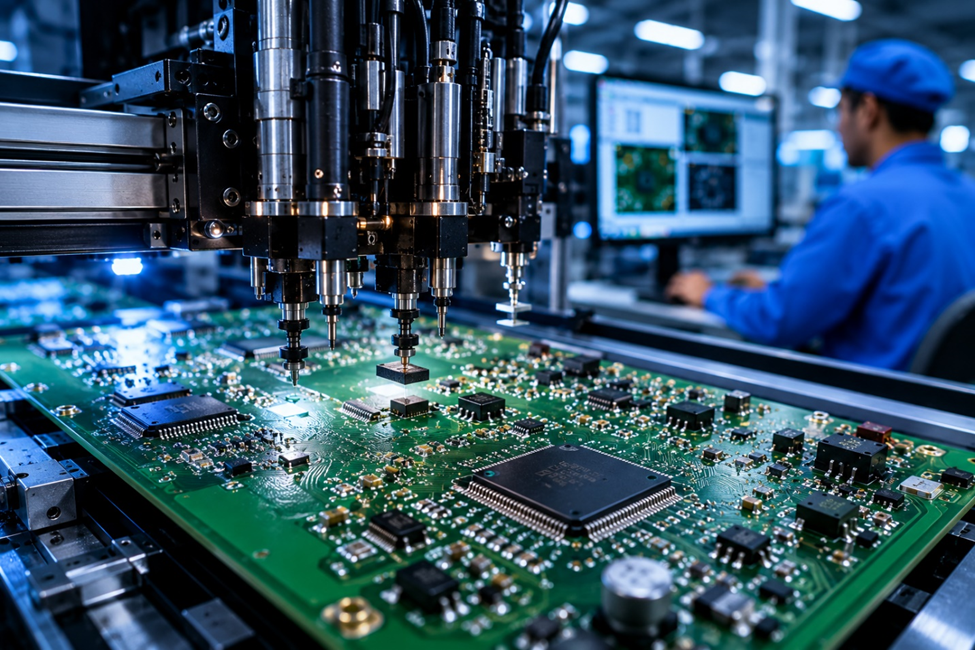
A printed circuit board assembly (PCBA) is the result of mounting electronic components — resistors, capacitors, ICs, connectors, and more — onto a bare PCB substrate using soldering processes. Modern SMT PCB assembly (Surface Mount Technology) places components on the board surface with automated pick-and-place machines, followed by reflow soldering in a
controlled oven environment. Through-hole technology (THT) is used where mechanical robustness or high current handling demands it.
Industrial PCB assembly today is largely automated, enabling extremely precise, repeatable placement of hundreds of components per board in a single production run. This is the foundation of virtually every modern consumer electronics product, EV battery management system, industrial controller, and aerospace sensor module.
What Is Traditional Wiring?
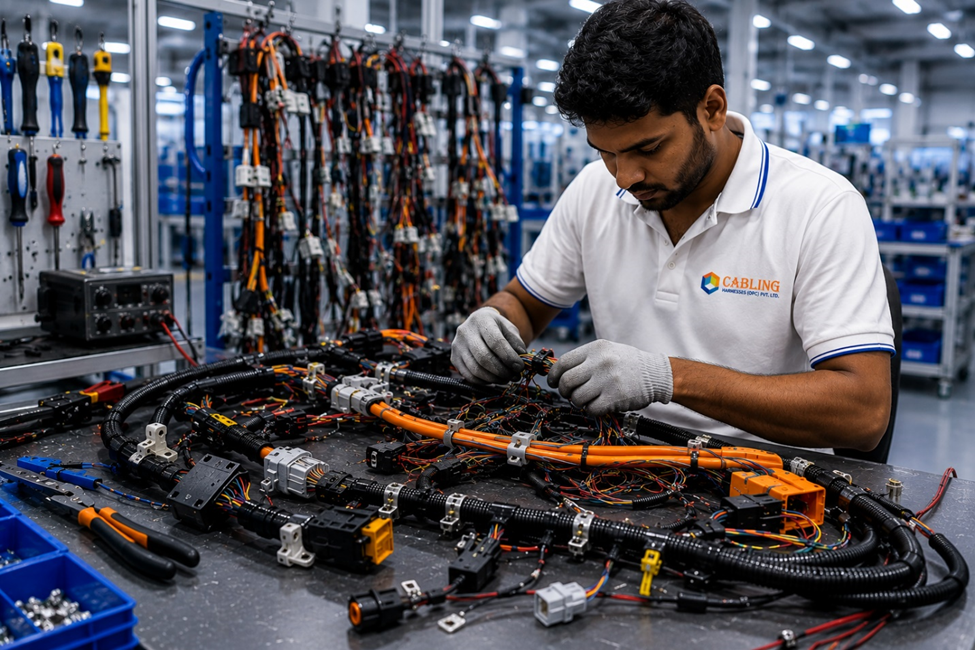
Traditional wiring — often executed as a wire harness or custom cable assembly — uses individual insulated conductors, terminals, connectors, and protective sleeving to route electrical signals and power between components or sub-systems. A wire harness manufacturer produces these as engineered bundles where wires are cut to length, terminated, routed through protective conduit, and assembled into a final harness that connects multiple nodes within a machine or vehicle.
Traditional wiring is the backbone of automotive electrical systems, aerospace and defense platforms, heavy industrial machinery, power distribution panels, and EV drivetrains — anywhere large conductor cross-sections, flexible routing, or high-voltage isolation is needed.
PCB Assembly vs Traditional Wiring: Technical Comparison
Design Complexity and Space Efficiency
PCB assembly consolidates entire electronic sub-systems onto a single board, dramatically reducing the physical footprint of a circuit. A board that integrates 200 discrete components and their interconnects occupies a fraction of the space that would be required by equivalent discrete wiring. This miniaturization is non-negotiable in modern EV battery management units, industrial IoT modules, and avionics systems.
Traditional wiring, by contrast, is inherently three-dimensional. Harnesses wind through chassis structures, around mechanical assemblies, and into tight enclosures. While less space-efficient on a per-circuit basis, this flexibility makes them indispensable for physically complex platforms like vehicle bodies, industrial robots, and aircraft frames — where rigid boards simply cannot follow the geometry.
Manufacturing Speed and Automation
Automated PCB assembly using SMT lines can place thousands of components per hour with sub-millimeter accuracy. A fully equipped SMT line — screen printer, pick-and-place machine, reflow oven, AOI inspection — can process dozens of boards per hour with minimal direct labor. This makes PCB assembly the clear choice for medium-to-high volume production runs where speed and repeatability are paramount.
Wire harness manufacturing, even with modern cutting and crimping automation, remains significantly more labor-intensive. Routing, bundling, tying, and testing a complex harness requires skilled technicians. Production throughput for custom cable assemblies is inherently lower per unit of complexity — but this is a trade-off that makes economic sense for low-volume, high-mix applications or where the harness serves a structural role that a PCB cannot.
Reliability and Fault Tolerance
When manufactured to specification, PCB assemblies offer exceptional reliability. Solder joints are mechanically and electrically stable; there are no crimped connections to loosen, no insulation to chafe, and no connector mating cycles to wear out. For electronics that must survive vibration, thermal cycling, humidity, and decades of continuous operation — as in aerospace, defense, and industrial automation — a well-designed PCBA with conformal coating is hard to beat.
Traditional wiring harnesses introduce more potential failure points: terminal resistance, connector corrosion, insulation damage, and wire fatigue. However, in power applications and high-vibration environments, properly specified harnesses with sealed connectors, strain relief, and heavy-gauge conductors deliver outstanding longevity. Many automotive and aerospace wire harnesses are engineered for 15–25-year service lives.
Maintenance and Repairability
This is one of the most meaningful practical differences between the two technologies. A faulty component on a PCB — particularly on a dense SMT board — requires skilled rework with specialist equipment. In the field, a board-level fault often means replacing the entire assembly rather than the individual failed component.
Wire harnesses, on the other hand, are relatively straightforward to repair. A damaged wire section can be spliced; a faulty connector can be replaced without specialized tools. For industrial machinery where uptime is critical, and field service technicians may have limited electronics expertise, this repairability is a significant operational advantage.
Cost Profile
Cost comparison between PCB assembly and traditional wiring is highly context dependent.
PCB Assembly Cost Drivers:
- NRE (Non-Recurring Engineering): PCB design, Gerber file creation, tooling, stencil fabrication
- Per-unit cost decreases steeply with volume due to automation
- Component procurement and bill of materials (BOM) complexity
- Testing: ICT, flying probe, functional test fixtures
Traditional Wiring Cost Drivers:
- Low NRE — tooling for crimp terminals and connectors is modest
- Per-unit cost is relatively flat with volume (labor-intensive process)
- Raw material costs: wire, terminals, connectors, conduit, tape
- Testing: continuity, hi-pot, pull force testing
For volumes above a few hundred units, PCB assembly typically wins on unit economics. For low-volume, high-complexity wiring — such as a one-off defense system or custom industrial machine — traditional wiring is often more cost-effective.
Detailed Comparison Table
| Parameter | PCB Assembly | Traditional Wiring |
| Space Efficiency | Excellent — compact, multilayer designs | Moderate — requires physical routing space |
| Manufacturing Speed | Very high — automated SMT lines | Moderate — labor-intensive bundling and termination |
| Volume Scalability | Excellent — unit cost drops sharply | Limited — labor cost remains relatively constant |
| Repairability | Complex — requires rework skills/equipment | Simple — field-repairable with basic tools |
| Reliability (Electronics) | Very high — no loose connections | Good — dependent on connector quality |
| High Current Handling | Limited — PCB traces have ampacity constraints | Excellent — large conductors handle kA-level currents |
| Design Flexibility | Board layout constrained by PCB rules | High — harnesses follow any physical geometry |
| NRE Cost | Higher — design, tooling, stencils | Lower — minimal tooling investment |
| Unit Cost (High Volume) | Low | Moderate to high |
| EMI Performance | Excellent with proper ground planes | Requires careful shielding design |
| Thermal Management | Requires thermal via and copper pour design | Conductor sizing handles heat naturally |
| Applicable Standards | IPC-A-610, J-STD-001 | IPC/WHMA-A-620, SAE, MIL-DTL |
When to Choose PCB Assembly?
PCB assembly services are the right choice when:
- Your product is an electronic controller, sensor module, power management unit, or communication device
- Production volumes exceed a few hundred units per year
- Miniaturization and weight reduction are design priorities
- EMI management and signal integrity are critical
- Your application demands the traceability and quality standards of PCB assembly India suppliers certified to IPC-A-610 Class 2 or Class 3
- You are developing EV battery management systems, industrial PLC modules, medical monitoring equipment, or IoT gateway hardware
When to Choose Traditional Wiring?
Wire harnesses and custom cable assemblies are the right choice when:
- Your application involves high-current power distribution (motor drives, battery packs, charging infrastructure)
- The electrical system must physically span a large platform — a vehicle, aircraft, or industrial machine
- Low volume, high customization is required
- Field serviceability and repair without specialized tools is a priority
- You need a shielded, strain-relieved connection between sub-assemblies that must move relative to each other
- Your platform uses EV wiring harnesses, automotive cable harnesses, or aerospace-grade interconnects that must comply with MIL-spec or automotive OEM requirements
The Future: PCB Assembly in EV and Industrial Automation
The transition to electric vehicles and intelligent automation is reshaping the relative roles of PCB assembly and wiring harnesses — not replacing one with the other, but integrating them more tightly than ever before.
Modern EV architectures are replacing distributed relay and fuse boxes with centralized zonal controllers — sophisticated PCBAs that aggregate dozens of previously discrete functions. At the same time, the raw power wiring for traction battery systems, motor inverters, and charging infrastructure demands high-ampacity harnesses with increasingly complex topologies.
In industrial automation, electronic manufacturing services providers are seeing rising demand for intelligent sensor nodes, edge computing modules, and servo drive electronics — all PCB-based — interconnected by ruggedized industrial harnesses. The two technologies are converging into hybrid assemblies where a PCB and its associated connector harness are engineered and qualified as a single functional unit.
For manufacturers planning product development over a 3–5 year horizon, the strategic implication is clear: both competencies matter, and partnering with a supplier who can handle both PCB assembly and wire harness manufacturing under one roof is a significant supply chain advantage.
Conclusion: Choosing the Right Solution for Your Application
There is no universal answer in the PCB assembly vs traditional wiring debate — only the right answer for your specific application, volume, environment, and business model. High-volume electronic products almost always benefit from PCB assembly services; physically complex, high-power platforms almost always require engineered wiring harnesses. The most demanding applications — EVs, industrial robots, defense electronics — require both, integrated with precision.
Understanding these differences at the design stage, before tooling and production commitments are made, is what drives efficient manufacturing, lower lifetime costs, and products that perform reliably in the field for years.
Partner with a Trusted PCB Assembly & Wiring Harness Manufacturer
Looking for reliable PCB assembly services, custom wiring harnesses, industrial cable assemblies, or OEM manufacturing support?
Cabling Harnesses (OPC) Pvt. Ltd. delivers precision-engineered solutions for EV, automotive, industrial automation, aerospace, defense, medical, and power applications — combining deep expertise in both PCB assembly and wiring harness manufacturing under one roof.
Our capabilities include:
- PCB Assembly Services (SMT & Through-Hole)
- SMT PCB Assembly with AOI and functional testing
- Custom Cable Assemblies
- EV Wiring Harnesses
- Industrial Wiring Harnesses
- Automotive Cable Harnesses
- Defense & Aerospace Harness Solutions
We support OEMs and global industries with export-quality manufacturing, reliable performance, and customized engineering support.
Frequently Asked Questions (FAQ)
Q1. What is the difference between PCB assembly and a wiring harness?
PCB assembly creates electronic circuits on a board, while wiring harnesses distribute power and signals between system components.
Q2. Which is more reliable — PCB assembly or traditional wiring?
Both are highly reliable when designed and manufactured to industry standards. PCBs suit electronic control systems, while wiring harnesses are ideal for power and field connections.
Q3. Is PCB assembly suitable for EV applications?
Yes. PCB assemblies are widely used in EV battery management systems, motor controllers, chargers, and electronic modules.
Q4. What is SMT PCB assembly? SMT (Surface Mount Technology) is an automated PCB assembly process where components are mounted directly onto the PCB surface for high-speed, high-precision manufacturing
Q5. How do I choose between PCB assembly and wiring for industrial automation?
PCBs are best for electronic controls and processing, while wiring harnesses are used for power distribution and machine connectivity. Most systems use both together.
Q6. Can Cabling Harnesses (OPC) Pvt. Ltd. provide both PCB assembly and wiring harness manufacturing?
Yes. Cabling Harnesses (OPC) Pvt. Ltd. offers PCB assembly services and custom wiring harness manufacturing for multiple industries.
Conclusion
PCB assembly and traditional wiring both play critical roles in modern electronics and industrial manufacturing. PCB assembly offers compact design, faster automated production, better scalability, and excellent reliability for electronic control systems. Traditional wiring harnesses remain essential for high-current applications, flexible routing, rugged environments, and easier field maintenance.
In industries like EV, automotive, aerospace, and industrial automation, both technologies are often integrated together to achieve optimal performance, efficiency, and long-term reliability. Choosing the right solution depends on your application, production volume, and operational requirements.
Contact Cabling Harnesses Today
📞 +91 73872 84670 / +91 9226275010
