

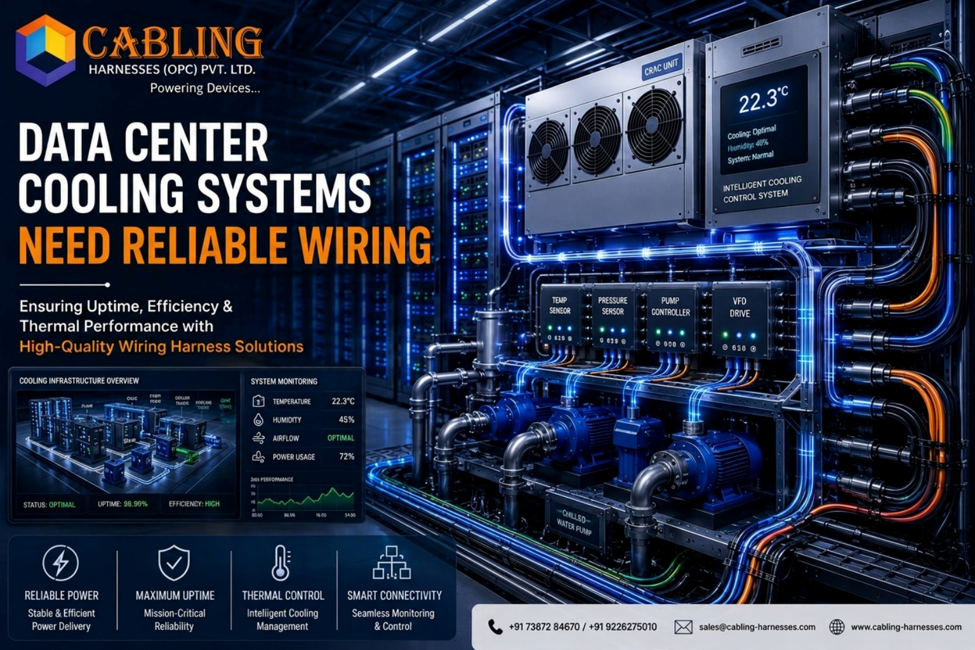
Why data center cooling systems demand reliable wiring harnesses explore engineering requirements, risks, and solutions for global buyers.
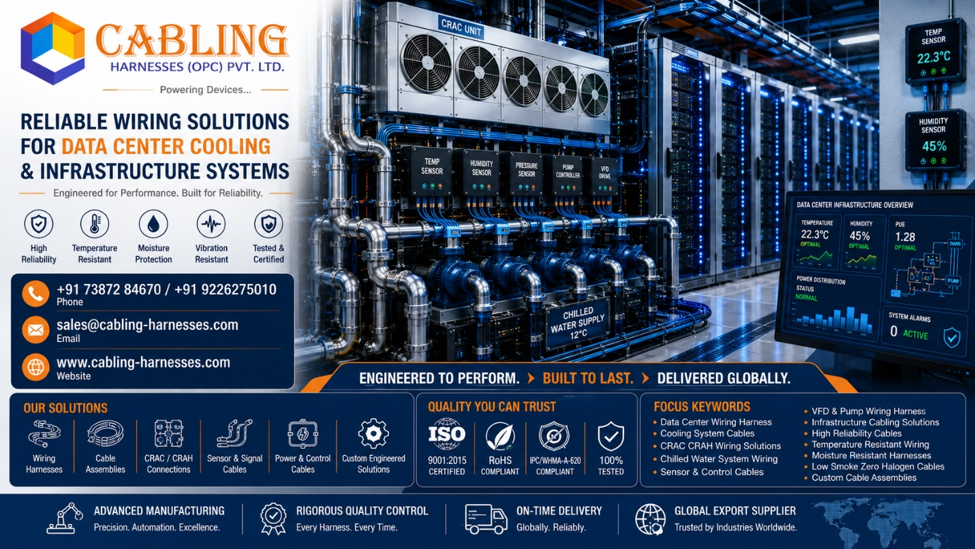
A data center that goes offline can cost businesses tens of thousands of dollars per minute. According to industry estimates, the average cost of data center downtime can exceed $9,000 per minute, a figure that has climbed steadily as organizations become increasingly dependent on always-on infrastructure. When analysts examine the root causes of these failures, thermal management issues consistently rank among the leading contributors. Behind every cooling system—whether it is a precision air handler, a chilled water unit, or a liquid cooling loop—is a network of wiring that controls, monitors, and powers the entire operation.
Yet wiring is frequently treated as an afterthought during data center planning. Engineers spend months selecting the right cooling architecture, optimizing airflow, and calculating load capacity, only to specify generic wiring during the procurement stage. This can be a costly mistake. The wiring harnesses inside cooling infrastructure endure mechanical stress, temperature fluctuations, vibration, and continuous electrical loads. They must be engineered for the environment rather than simply selected from a catalog.
This article examines what makes data center cooling systems particularly demanding on wiring, the consequences of poor wiring decisions, and what procurement teams and engineers should consider when specifying wiring harnesses for cooling applications.
The Role of Wiring in Data Center Cooling Systems
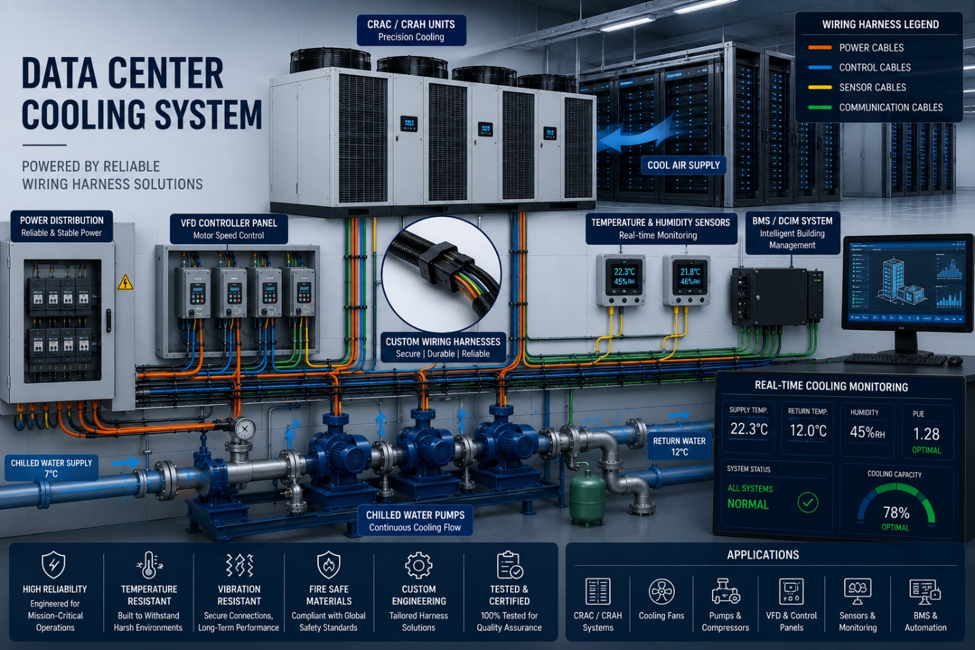
Modern data center cooling systems are complex and highly integrated. They typically include Computer Room Air Conditioning (CRAC) units, Computer Room Air Handling (CRAH) units, in-row cooling modules, rear-door heat exchangers, chilled water distribution loops, and increasingly direct liquid cooling systems that bring coolant into direct contact with server components.
Each of these systems relies on wiring for three essential functions:
- Power Delivery: Compressors, fans, pumps, and control boards require stable, properly rated power connections.
- Signal and Control: Temperature sensors, pressure transducers, variable frequency drives (VFDs), and building management systems (BMS) rely on low-voltage signal wiring to coordinate cooling responses in real time.
- Communication: Smart cooling systems use data cables, including structured cabling and Ethernet connections, to transmit telemetry to monitoring platforms and Data Center Infrastructure Management (DCIM) software.
Poor wiring at any of these levels introduces significant risk. A loose power connection in a CRAC unit can trigger intermittent compressor failures. A degraded signal cable can cause a sensor to report inaccurate temperatures, leading the control system to undercool a hot aisle. A corroded connector in a chilled water pump controller can delay system response during a thermal event. None of these failures typically provide advance warning.
Why Cooling Environments Are Particularly Demanding on Wiring?
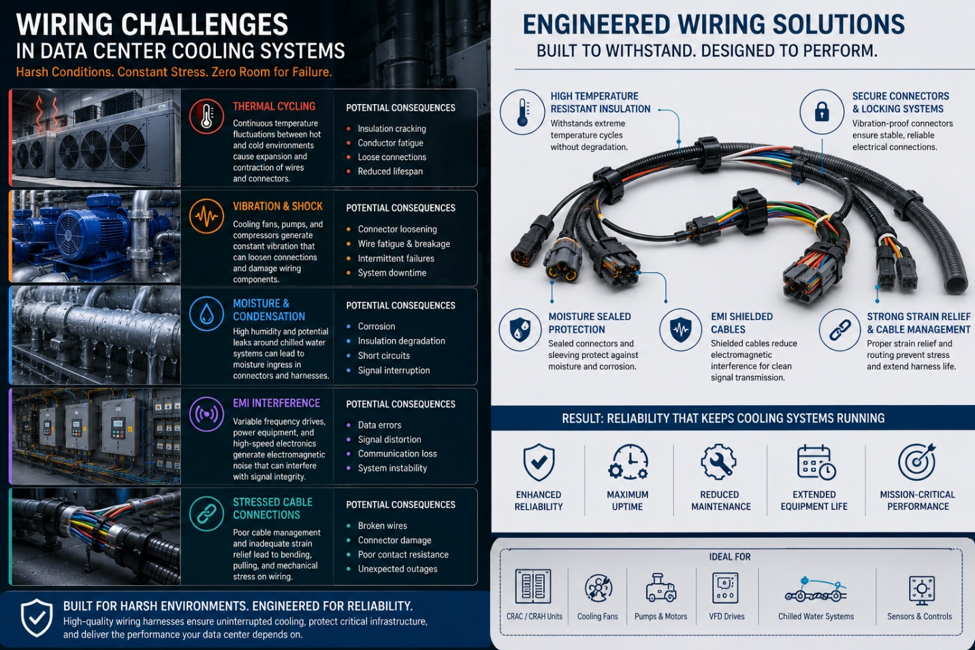
It is tempting to assume that wiring in a climate-controlled data center operates in a relatively benign environment. In reality, the areas inside and around cooling equipment present several challenges that general-purpose wiring is not designed to withstand over the long term.
Thermal Cycling
Cooling systems cycle on and off repeatedly throughout the day and night. Each cycle exposes wiring to temperature fluctuations that cause expansion and contraction, gradually stressing conductor insulation and connector joints. In high-density deployments, localized heat near compressors and power modules can push temperatures well beyond normal ambient levels.
Vibration and Mechanical Stress
Compressors, fans, and pumps generate continuous vibration. Without proper strain relief, vibration-induced fatigue can cause conductor fractures and connector separation over time. Wiring harnesses that are not specifically designed and assembled for vibration resistance are more likely to fail, often when systems are operating under maximum load.
Moisture and Condensation
Chilled water systems and direct expansion (DX) cooling units can create conditions where condensation occurs, particularly if air sealing is inadequate or humidity control fluctuates. Moisture exposure can accelerate oxidation on connectors and terminals, increase contact resistance, and, in severe cases, lead to short circuits.
Continuous Electrical Load
Unlike many industrial machines that operate intermittently, data center cooling systems typically run 24 hours a day, 7 days a week. This continuous operation means wiring designed for intermittent duty may degrade faster than expected. Conductors must be correctly sized for continuous-duty applications, and insulation materials must maintain their performance under sustained thermal loads.
The Real Cost of Substandard Wiring in Cooling Infrastructure
When wiring fails within a data center cooling system, the consequences can escalate rapidly.
Consider a common scenario: a VFD controlling a cooling fan receives an intermittent signal because of a degraded control cable. The VFD interprets the signal as fault condition and reduces fan speed. Server inlet temperatures begin to rise. The thermal management system generates an alarm, but by the time maintenance personnel investigate, one or more server racks may have throttled performance to prevent overheating, resulting in service degradation across virtualized workloads.
This is not merely a theoretical example. Data center operators routinely trace performance incidents and unplanned downtime back to wiring faults that are difficult to detect during routine inspections. These problems often develop gradually—connector resistance increases over time, insulation deteriorates due to thermal cycling, or shielding performance declines until signal integrity becomes unacceptable.
Beyond operational risk, substandard wiring can also create compliance and insurance concerns. Many enterprise and hyperscale facilities operate under up-time commitments that require Tier III or Tier IV infrastructure standards. Wiring failures that compromise system redundancy can jeopardize those classifications and potentially result in contractual penalties.
What Procurement Teams Should Specify for Cooling System Wiring
Selecting the right wiring harnesses for data center cooling applications requires looking beyond simple price comparisons. Procurement and engineering teams should evaluate suppliers based on several critical factors.
Conductor Material and Sizing
High-purity copper conductors remain the preferred choice for both power and signal applications within cooling equipment. Conductor sizing should be based on continuous-duty operating conditions rather than peak loads alone. Undersized conductors generate additional heat, increasing the thermal burden that the cooling system is intended to manage.
Insulation and Jacket Materials
Cross-linked polyethylene (XLPE) and silicone rubber insulation materials offer superior thermal performance compared to standard PVC in high-temperature environments. For cable routes in conditioned spaces, high-quality Low Smoke Zero Halogen (LSZH) compounds provide enhanced fire safety and chemical resistance.
Insulation materials that comply with UL, IEC, and RoHS requirements help ensure predictable long-term performance.
Connector Quality and Locking Mechanisms
Connectors used in cooling applications should incorporate secure locking mechanisms to prevent loosening caused by vibration. Gold-plated or silver-plated contacts help reduce oxidation in humid environments.
For signal circuits, shielded connectors with proper shield termination are essential for minimizing electromagnetic interference generated by VFDs and motor drives.
Custom Harness Design and Routing
Standard cable assemblies rarely match the exact routing requirements of cooling equipment. Custom-designed wiring harnesses reduce installation complexity, eliminate unnecessary cable length, improve airflow, and ensure that strain-relief points are positioned correctly relative to vibration sources.
Testing and Certification
Every wiring harness used in a critical cooling application should be supplied with documented electrical testing results, including:
- Continuity testing
- Insulation resistance testing
- High-potential (Hi-Pot) testing
- Functional verification
For sensitive signal circuits, impedance and crosstalk testing may also be required. Reputable manufacturers provide complete test documentation to support traceability throughout the product lifecycle.
Why Sourcing from a Specialist Manufacturer Matters?
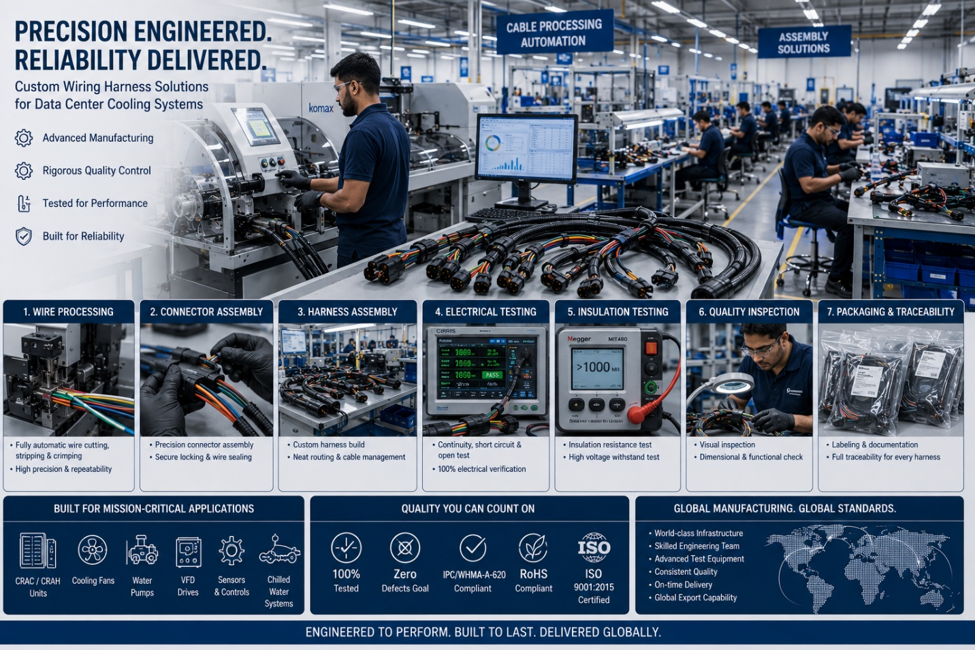
The global market for data center infrastructure continues to expand rapidly. New hyperscale facilities are being developed across North America, Europe, the Middle East, and Asia, while edge data centers are being deployed closer to end users. These projects require wiring harnesses that meet stringent reliability standards, and demand is increasingly shifting toward manufacturers with proven engineering expertise rather than commodity suppliers.
For OEMs producing cooling equipment, wiring harness quality directly impacts product reliability, warranty costs, and customer satisfaction. Partnering with a manufacturer that offers design support, prototyping, custom engineering, and in-house testing creates a value proposition that generic suppliers often cannot match.
For procurement managers sourcing replacement or upgrade harnesses, receiving components manufactured and tested to precise specifications significantly reduces the likelihood of field failures.
Frequently Asked Questions
What types of wiring harnesses are used in data center cooling equipment?
Data center cooling systems utilize several types of wiring harnesses, including power harnesses for compressors, pumps, and fans; control and signal harnesses for sensors, actuators, and VFDs; and communication cables for BMS integration and DCIM connectivity. Each category has unique requirements regarding conductor sizing, insulation materials, shielding, and connector specifications.
How does wiring quality affect data center uptime?
Wiring faults are a common cause of cooling system failures. Faulty signal cables can produce inaccurate sensor readings, while failed power connections can disable cooling equipment entirely. Since cooling failures can quickly lead to server overheating, even minor wiring defects may result in significant operational disruptions.
What standards should wiring harnesses for cooling systems meet?
Relevant standards include UL 508A for industrial control panel wiring, IEC 60364 for low-voltage electrical installations, IEC 62368-1 for IT and electronic equipment safety, and RoHS compliance requirements for international markets. Many OEMs also maintain additional internal specifications for their suppliers.
Can standard off-the-shelf cables be used in data center cooling applications?
Standard cables may be suitable for low-risk routes in conditioned environments. However, high-stress areas near compressors, motor drives, and chilled water systems typically require purpose-designed wiring harnesses that are optimized for thermal, mechanical, and environmental demands.
How do I find a reliable wiring harness manufacturer for cooling equipment applications?
Look for manufacturers with proven experience in industrial wiring solutions, in-house engineering and prototyping capabilities, documented quality control processes, comprehensive testing procedures, and a strong track record of serving OEMs in the HVAC, cooling, and industrial equipment sectors.
Conclusion
Data center cooling systems are mission-critical infrastructure, and the wiring that supports them must be treated with the same level of importance. Engineers, OEMs, and procurement managers who apply rigorous standards to wiring harness selection can build cooling systems that deliver reliable performance, maintain compliance, and reduce total ownership costs throughout the equipment lifecycle.
Cutting corners on wiring specifications rarely produces meaningful savings. Instead, it often shifts costs to future maintenance, downtime, and system failures. Partnering with a specialist wiring harness manufacturer is an investment in long-term operational reliability and business continuity.
Partner with Cabling Harnesses for Your Next Project
At Cabling Harnesses (OPC) Private Limited, we specialize in custom wiring harness design, prototyping, and manufacturing for industrial, cooling, and power applications. Our team works closely with OEMs, equipment manufacturers, and global procurement teams to deliver precision-engineered wiring solutions that meet international quality standards and demanding operational requirements.
Whether you are designing a new cooling product line, upgrading an existing installation, or sourcing reliable harnesses for a critical infrastructure project, we are ready to support your requirements from specification through delivery.
Get in touch with our team today:
📞 +91 73872 84670 / +91 9226275010
✉️ sales@cabling-harnesses.com
We welcome inquiries from manufacturers, OEMs, distributors, and procurement teams worldwide. Let us discuss how we can support your next project.
